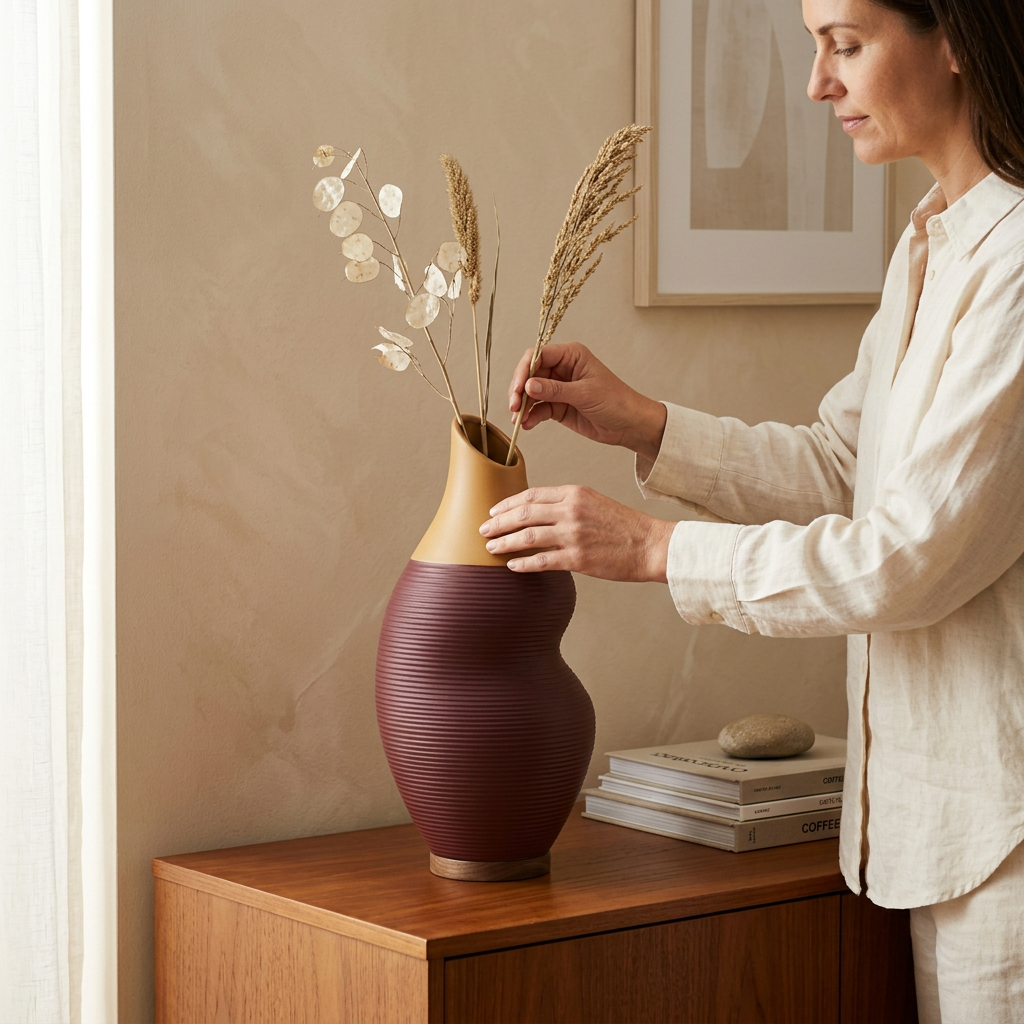
Burgundy & Ochre Sculptural Dry-Stem Vase with Fine Horizontal Ridges, an Angled Opening and a Walnut-Tone Foot
Burgundy & Ochre Sculptural Dry-Stem Vase with Fine Horizontal Ridges, an Angled Opening and a Walnut-Tone Foot
Couldn't load pickup availability

Burgundy & Ochre Sculptural Dry-Stem Vase with Fine Horizontal Ridges, an Angled Opening and a Walnut-Tone Foot
🌿 A little sculpture. A different kind of centerpiece.
Some corners do not need more decoration. They need one object with a stronger point of view. This burgundy and ochre vase brings a flowing, asymmetric silhouette to the living room, pairing closely spaced horizontal ridges with a smooth, slanted neck. A small walnut-tone foot creates a final dark line beneath the body, giving the composition a distinct beginning and end.
The result is expressive without a printed pattern or a slogan. A generous lower curve narrows, then opens into a second softer swell before reaching the ochre neck. From one angle, the outline feels almost continuous; turn it slightly and the inward curve becomes the defining detail.
The interest is in the transition
Fine ribs travel around the burgundy body, catching side light along their upper edges. Above them, the ochre surface looks quieter and more uninterrupted. The meeting of the two colors is deliberately noticeable: texture below, a calmer field above. Rather than competing for attention, these contrasting surfaces make each other more legible.

Begin with nothing inside
Place the empty vase on a console and look at its outline before adding stems. The angled opening already provides direction, while the curved body makes a complete arrangement on its own. Beside a low stack of books, it introduces height without requiring a large bouquet. Leave clear space beside the narrower waist so the sculptural contour is not hidden.
For a fuller composition, choose a few lightweight dry stems with different heights. Let the tallest extend from the higher side of the opening, and keep the other stems loose rather than compressed into a dense bunch. A restrained arrangement allows the ochre neck to remain visible and keeps the vase, not just its contents, part of the scene.
Three colors to build around
Cream gives the burgundy a clean backdrop and makes the ridges easier to see. Olive creates an earthy connection with the ochre neck. Dark timber echoes the foot and makes the entire arrangement feel more settled. You only need one of these connections; repeating every color can make a room feel overly coordinated.

A console, a sideboard, a quieter shelf
On a long sideboard, position the vase away from the center and balance it with something lower at the opposite end. On a shelf, allow room above the slanted opening rather than squeezing it beneath the next board. Near a reading chair, place it where it will not interfere with a lamp switch or your usual reach for a book.
Rotate the vase until its inward curve is visible from the place you sit most often. This small adjustment can reveal more of the design than adding another accessory. If the surrounding room already has strong patterns, use dry stems in a single neutral tone or leave the vase empty.

Know the piece before bringing it home
This listing is for one decorative vase. Botanical stems and other styling objects are not included. Use for dry decorative arrangements; watertight construction and suitability for fresh flowers in water are not established. The finish is described by its visible color and texture, not as a confirmed ceramic composition or solid-wood species. Check the final dimensions and material-specific care information against your chosen placement.
Gift-box photography shows the proposed closed-box presentation. Gift packaging is not included in the current product specification. A shape this considered does not need to be surrounded by much. Give it light, a little space, and a place in your everyday view.